← All Industries
Science & Research
Scientific & Research Chillers
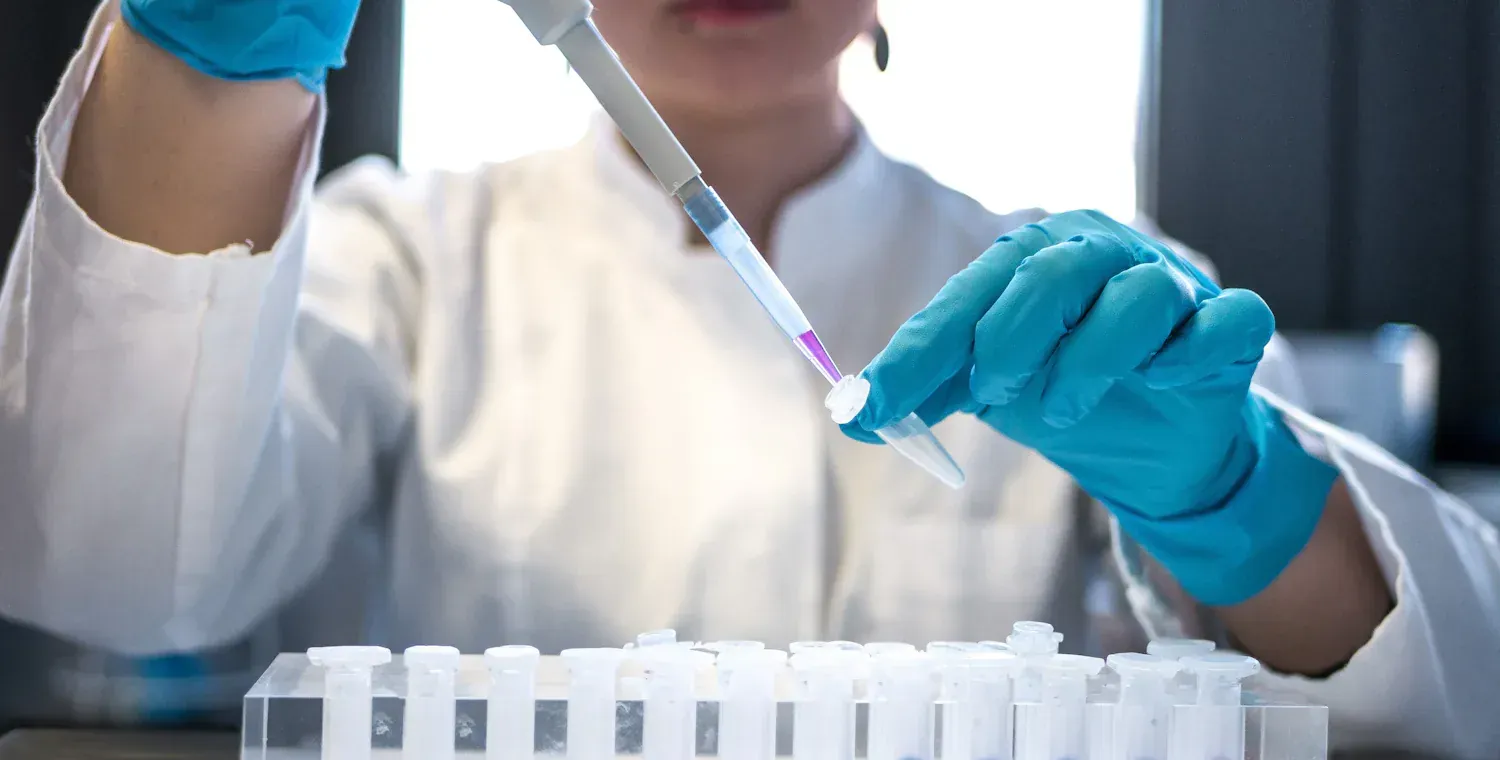
Precision cooling for laboratory research equipment, environmental chambers, NMR systems, and particle accelerator support.
View Recommended Chillers
Precision cooling for laboratory research equipment, environmental chambers, NMR systems, and particle accelerator support.
View Recommended ChillersResearch equipment requires exceptional thermal stability for reproducible results. NMR magnets need cryogenic management to hold field homogeneity within ppm tolerances; environmental chambers demand ±0.1–0.5°C control; particle accelerator RF cavities dissipate megawatt-level power that the coolant must remove without temperature excursion.
In research, the chiller protects irreplaceable equipment and the validity of experiments that may represent years of work and millions in grant funding.
Common process cooling problems in Science & Research and why getting the chiller right matters.
NMR and some material science work require operation toward the liquid-helium range. Standard chillers reach −30°C at best; cryogenic service needs specialized cascade systems and expert integration.
Environmental chambers run 500+ hour tests at ±0.2°C. A 1°C drift over 10 hours is a failure. This needs high-resolution feedback and laboratory-grade proportional control.
Accelerator RF cavities and precision optics are damaged by particulate. Chillers must maintain extreme purity and very low water content; a seal failure can contaminate irreplaceable equipment.
Our chillers integrate directly with the process equipment that Science and Research relies on. These are the systems we most often cool — each with its own temperature target, flow, and failure mode we size for.
The chiller supports magnet cooling and cryo-compressor heat rejection.
The chiller holds detector and source temperature for stable results.
The chiller removes heat that drives wavelength and power drift.
The chiller drives the cold side of research thermal cycling.
Chiller systems most commonly matched to Science & Research applications.

Standard Series
40°F / 4°C
1/3-40 Ton
Laboratory-grade precision cooling for research instruments and environmental chambers requiring tight, repeatable stability.
Get a Quote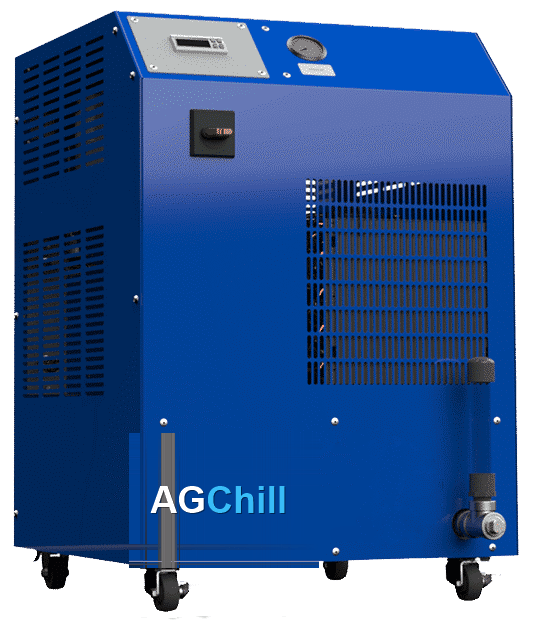
LT Series
10°F / -12°C
1/2-30 Ton
Low-temperature cooling for material testing chambers and equipment needing sub-ambient fluid temperatures.
Get a Quote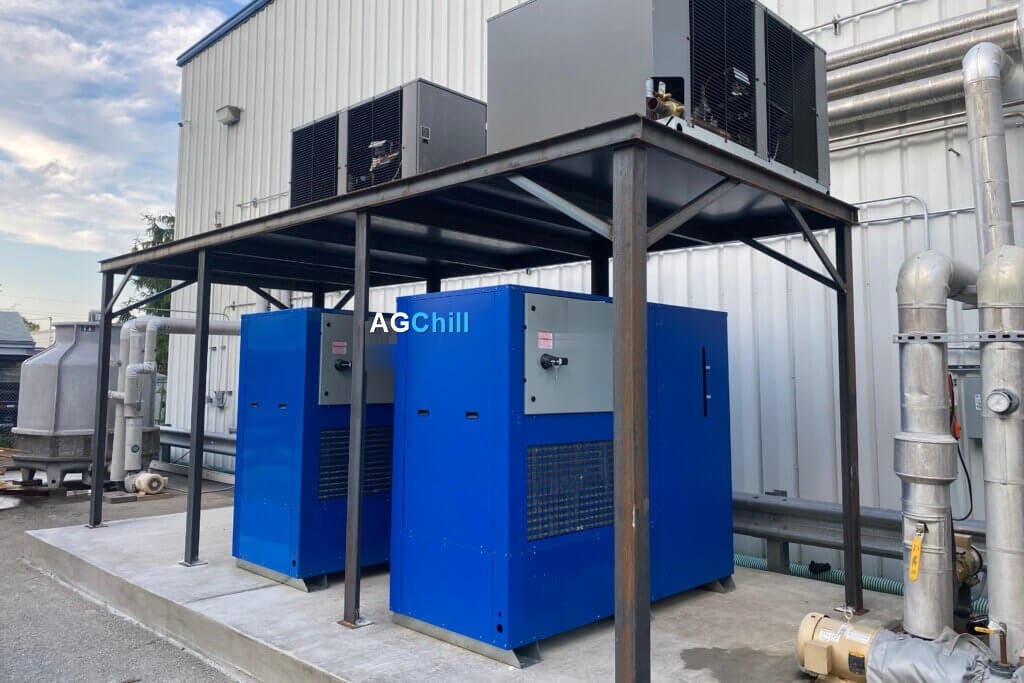
ULT Series
-112°F / -80°C
1/2-20 Ton
Ultra-low temperature and cryogenic-compatible cooling for NMR support, deep environmental testing, and advanced research.
Get a QuoteIn research, a cooling failure can quench a magnet or invalidate months of irreplaceable data.
NMR magnet chiller failure accelerates cryogenic boil-off; the magnet warms past threshold and quenches — a permanent $500K–2M loss with 6–12 months of downtime while it’s replaced and re-shimmed. Environmental chamber instability invalidates test data, forcing weeks of reruns. Particle accelerator cooling failure surges cavity temperature, collapses RF efficiency, and halts all user experiments.
$2M
Cost of a quenched NMR magnet
±0.1°C
Stability long-duration research demands
6–12 mo
Downtime to replace a quenched magnet
Whether you're researching options or ready to order, AG Chill can help.
Research scientists and lab managers at universities or national labs researching NMR chillers, environmental chamber cooling, and cryogenic thermal management.
Principal investigators evaluating chillers for a new project — needs stability documentation, long-term reliability data, equipment-integration support, and staff training.
University facilities managers or department chairs approving capex. Need grant-friendly terms, a 5+ year warranty, on-campus or remote service, and educational pricing.
Research cooling is split between proprietary instrument-OEM systems and premium lab chillers. AG Chill offers value and independence.
Instrument OEMs purpose-design cooling for their instruments but charge premium spares and restrict maintenance to the manufacturer. AG Chill captures standalone and multi-instrument cooling.
Cryogen suppliers excel at cryogen supply but not precision cooling engineering, and at high cost. AG Chill’s integrated approach combines convenience and value.
Specialty precision chiller makers offer excellent precision but at a 50–100% premium that strains academic budgets. AG Chill’s value positioning captures price-sensitive labs.
Lab-assembled cooling loops are unreliable with poor control and contamination risk. AG Chill’s integrated, warrantied solution protects expensive research.
Buying guides and technical resources for Science & Research process cooling.
Buying Guide
Recirculating chillers for lasers, rotary evaporators, reactors, and instruments.
Read the Guide ›Sizing Guide
Heat load, flow rate, temperature differential, and ambient — how each one drives the size you actually need.
Read the Guide ›Selection Guide
Installation, operating cost, maintenance, and application fit — which setup makes sense for your facility.
Read the Guide ›Real-world results from Science & Research customers.
We are actively documenting customer results from Science & Research installations. These will be published here as case studies are completed. Have a project to discuss? We are happy to talk through your application.
Discuss Your ApplicationTell us your target temperature, flow rate, and heat load. AG Chill will identify the right system for your Science & Research application.
For NMR, environmental chambers, and precision laboratory-equipment cooling that needs stable temperature.
Experiments and instruments fall out of spec, invalidating results and risking equipment.